
Sidebar
News Press

Administrator
Industrial Ethernet Switch Applied to Taizhou Yangtze River Bridge
Project Introduction
The main bridge of Taizou Yangtze River Bridge is the first triple-towered double-super-span steel suspension bridge in the world. The full length of main bridge and the approach is 9,726 m, the width of deck is 33 m.The bridge shortened the highway travel distance between Taizhou and Changzhou from 150 km to 30 km and reduced travel time from 1.5 to 0.5 hours. The solution provider applied Bueno industrial ethernet switches in the network infrastructure of the Integrated Environmental Monitoring System, which refers to the process of implementing environmental data collection and broadcasts.
System Requirements
1.Serial device server integrated Ethernet switches are required to connect peripheral serial devices and form a redundant fiber ring. 2.The devices should be able to work under damp and high temperature harsh ocean environments. 3.The devices should be anti corrosion due to the strong salt spray fog. 4.High EMC performance for the usage of the devices in high electromagnetic interference.
Bueno Solution
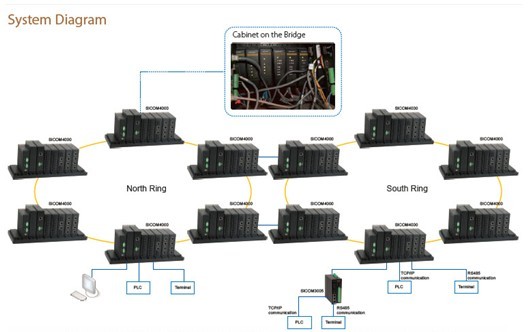
Bueno offers the network solution for the whole system, which is consists of vehicle control, bridge information broadcasting, power monitoring, bridge weather station, steel structure drying, and aircraft warning light systems. There are 23 pcs of industrial Ethernet switches deployed in the North and South fast Ethernet redundant fiber rings that control 33 message sign boards, 39 street lights, 39 power monitoring stations, 4 bridge weather stations, 5 vehicle license plate recognition devices, and 24 aircraft warning lights on the top of 3 200m height bridge towers. The system ensures all traffic and weather information are reliably broadcasted and keeps traffic running smoothly and safely.
The erosion of the materials caused by huge salt spray fog brings a huge challenge for the devices working in such an river environment. However, Bueno industrial Ethernet switches are specially designed for such a harsh environment, and its outstanding anti-corrosion performance with the conformal coating design, wide operation temperature and high EMC level features enable the devices to perform with unprecedented reliability and stability.
Smart Home(Home Automation)
Home automation (also called domotics or Smart Home) is the residential extension of "building automation". It is automation of the home, housework or household activity. Home automation may include centralized control of lighting, HVAC (heating, ventilation and air conditioning), appliances, and other systems, to provide improved convenience, comfort, energy efficiency and security. Home automation for the elderly and disabled can provide increased quality of life for persons who might otherwise require caregivers or institutional care.
The popularity of home automation has been increasing greatly in recent years due to much higher affordability and simplicity though smartphone and tablet connectivity. The concept of the "Internet of Things" has tied in closely with the popularization of home automation.
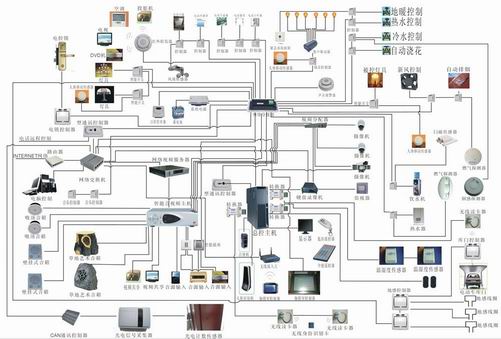
A home automation system integrates electrical devices in a house with each other. The techniques employed in home automation include those in building automation as well as the control of domestic activities, such as home entertainment systems, houseplant and yard watering, pet feeding, changing the ambiance "scenes" for different events (such as dinners or parties), and the use of domestic robots. Devices may be connected through a computer network to allow control by a personal computer, and may allow remote access from the internet. Through the integration of information technologies with the home environment, systems and appliances are able tocommunicate in an integrated manner which results in convenience, energy efficiency, and safety benefits.
Automated homes of the future have been staple exhibits for World's Fairs and popular backgrounds in science fiction. However, problems with complexity, competition between vendors, multiple incompatible standards, and the resulting expense have limited the penetration of home automation to homes of the wealthy, or ambitious hobbyists. Possibly the first "home computer" was an experimental home automation system in 1966.
Overview and benefits
Home automation refers to the use of computer and information technology to control home appliances and features (such as windows or lighting). Systems can range from simple remote control of lighting through to complex computer/micro-controller based networks with varying degrees of intelligence and automation. Home automation is adopted for reasons of ease, security and energy efficiency.
In modern construction in industrialized nations, most homes have been wired for electrical power, telephones, TV outlets (cable or antenna), and a doorbell. Many household tasks were automated by the development of specialized appliances. For instance, automatic washing machines were developed to reduce the manual labor of cleaning clothes, and water heaters reduced the labor necessary for bathing.
Other traditional household tasks, like food preservation and preparation have been automated in large extent by moving them into factory settings, with the development of pre-made, pre-packaged foods, and in some countries, such as the United States, increased reliance on commercial food preparation services, such as fast foodrestaurants. Volume production and the factory setting allows forms of automation that would be impractical or too costly in a home setting. Standardized foods enable possible further automation of handling the food within the home.
The use of gaseous or liquid fuels, and later the use of electricity enabled increased automation in heating, reducing the labor necessary to manually refuel heaters andstoves. Development of thermostats allowed more automated control of heating, and later cooling.
As the number of controllable devices in the home rises, interconnection and communication becomes a useful and desirable feature. For example, a furnace can send an alert message when it needs cleaning, or a refrigerator when it needs service. Rooms will become "intelligent" and will send signals to the controller when someone enters. If no one is supposed to be home and the alarm system is set, the system could call the owner, or the neighbors, or an emergency number.
In simple installations, domotics may be as straightforward as turning on the lights when a person enters the room. In advanced installations, rooms can sense not only the presence of a person inside but know who that person is and perhaps set appropriate lighting, temperature, music levels or television channels, taking into account the day of the week, the time of day, and other factors.
Other automated tasks may include setting the HVAC to an energy saving setting when the house is unoccupied, and restoring the normal setting when an occupant is about to return. More sophisticated systems can maintain an inventory of products, recording their usage through bar codes, or an RFID tag, and prepare a shopping list or even automatically order replacements.
Home automation can also provide a remote interface to home appliances or the automation system itself, via telephone line, wireless transmission or the internet, to provide control and monitoring via a smartphone or web browser.
An example of remote monitoring in home automation could be triggered when a smoke detector detects a fire or smoke condition, causing all lights in the house to blink to alert any occupants of the house to the possible emergency. If the house is equipped with a home theater, a home automation system can shut down all audio and video components to avoid distractions, or make an audible announcement. The system could also call the home owner on their mobile phone to alert them, or call the fire department or alarm monitoring company.
In terms of lighting control, it is possible to save energy when installing various products. Simple functions such as motion sensors and detectors integrated into a relatively simple home automation system can save hours of wasted energy in both residential and commercial applications. For example imagine an auto on/off at night time in all major city office buildings, say after 10pm. When no motion is detected, lights shut down, and the owner could save kilowatts of wasted overnight energy. Similar controls on HVAC (Heating Ventilation and Air Conditioning )in buildings could save even more energy.
History
Home automation has been a feature of science fiction writing for many years, but has only become practical since the early 20th Century following the widespread introduction of electricity into the home, and the rapid advancement of information technology. Early remote control devices began to emerge in the late 1800s. For example, Nikola Tesla patented an idea for the remote control of vessels and vehicles in 1898.
The emergence of electrical home appliances began between 1915 and 1920; the decline in domestic servants meant that households needed cheap, mechanical replacements. Domestic electricity supply, however, was still in its infancy - meaning this luxury was afforded only the more affluent households.
Ideas similar to modern home automation systems originated during the World's Fairs of the 1930s. Fairs in Chicago (1934), New York (1939) and (1964–65), depicted electrified and automated homes. In 1966 Jim Sutherland, an engineer working for Westinghouse Electric, developed a home automation system called "ECHO IV"; this was a private project and never commercialized. The first "wired homes" were built by American hobbyists during the 1960s, but were limited by the technology of the times. The term "smart house" was first coined by the American Association of Housebuilders in 1984.
With the invention of the microcontroller, the cost of electronic control fell rapidly. Remote and intelligent control technologies were adopted by the building services industry and appliance manufacturers worldwide, as they offer the end user easily accessible and/or greater control of their products.
During the 1990s home automation rose to prominence. By the end of the decade, domotics was commonly used to describe any system in which informatics and telematicswere combined to support activities in the home. The phrase appears to be a portmanteau word formed from domus (Latin, meaning house) and informatics, and therefore refers specifically to the application of computer and robot technologies to domestic appliances.
Despite interest in home automation, by the end of the 1990s there was not a widespread uptake - with such systems still considered the domain of hobbyists or the rich. The lack of a single, simplified, protocol and high cost of entry has put off consumers.
System elements
Elements of a home automation system include sensors (such as temperature, daylight, or motion detection), controllers (such as a general-purpose personal computer or a dedicated automation controller) and actuators, such as motorized valves, light switches, motors, and others. One or more human-machine interface devices are required, so that the residents of the home can interact with the system for monitoring and control; this may be a specialized terminal or, increasingly, may be an application running on a smart phone or tablet computer. Devices may communicate over dedicated wiring, or over a wired network, or wirelessly using one or more protocols. Building automation networks developed for institutional or commercial buildings may be adapted to control in individual residences. A centralized controller can be used, or multiple intelligent devices can be distributed around the home.
Networks
There have been many attempts to standardize the forms of hardware, electronic and communication interfaces needed to construct a home automation system. Some standards use additional communication and control wiring, some embed signals in the existing power circuit of the house, some use radio frequency (RF) signals, and some use a combination of several methods. Control wiring is hardest to retrofit into an existing house. Some appliances include a USB port that is used for control and connection to a domotics network. Protocol bridges translate information from one standard to another, e.g., from X10 to European Installation Bus.
Tasks
HVAC
Heating, Ventilation and Air Conditioning (HVAC) solutions can include temperature and humidity control, and more commonly in Europe, fresh air, heating and natural cooling. Home automation solutions are varied and could include an internet-controlled thermostat, by allowing the homeowner to control the building's heating and air conditioning systems remotely, or it could be linked to windows to allow automated opening and closing to allow hot air out and cool air in to allow for cooling of thethermal mass of the house structure. Many systems are designed to not only provide convenience but to also allow for better energy efficiency.
Lighting
Lighting control systems can be used to control household electric lights. Examples include:
- Extinguish all the lights of the house at a predetermined time and date range
- Use of motion detectors to automatically extinguish the lights in a room after occupants have left and turn on the lights if occupants enter a room
- Turn the light on or off with the use of a remote wireless device
- Control the brightness of the lights according to the level of ambient light available, or other criteria
- Change the ambient colour of a room via the lights used or by using RGB LEDs (mood control)
Natural lighting control involves controlling window shades, LCD shades, draperies and awnings.
Audio-visual
This category includes audio and video switching and distribution. Multiple audio or video sources can be selected and distributed to one or more rooms and can be linked with lighting and blinds to provide mood settings.
Shading
Automatic control of blinds and curtains can be used for:
- Presence simulation
- Privacy
- Temperature control
Security
Control and integration of security systems and also the potential for central locking of all perimeter doors and windows.
With Home Automation, the consumer can select and watch cameras live from an Internet source to their home or business. Security cameras can be controlled, allowing the user to observe activity around a house or business right from a Monitor or touch panel. Security systems can include motion sensors that will detect any kind of unauthorized movement and notify the user through the security system or via cell phone. This category also includes control and distribution of security cameras (seesurveillance).
- Intrusion Detection
- Motion sensors
- Magnetic contact sensors for doors / windows
- Glass break detectors
- Pressure sensors
- Presence Simulation
- Detection of fire, gas leaks and water leaks (see fire alarm and gas alarm)
- Medical alert / teleassistance.
- Precise and safe blind control
Intercoms
An intercom system allows communication via a microphone and loud speaker between multiple rooms. Integration of the intercom to the telephone, or of the video door entry system to the television set, allowing the residents to view the door camera automatically.
Domestic robotics (domotics)
See also: Domestic robot
Journalist Bruno de Latour coined the term domotic in 1984. Domotic has been recently introduced in vocabulary as a composite word of Latin word domus andinformatics, or a contraction of domestic robotics, and it refers to intelligent houses meaning the use of the automation technologies and computer science applied to the home.
The Spanish Domótica, French Domotique, Italian Domotica, Portuguese Domótica and a number of other words in other languages also derive from Latin word domus and "Robotic...", "Informatic..." or "Automatic...".
Domotics includes completely automated systems that control entertainment, heating, broadband, lighting and security from one of many types of digital computer control devices, panels and mobile handset. Domotics is used to improve the quality of life increasing comfort, security and the same time obtaining costs and energy savings. The term covers a range of applications:
- Domotics is the discipline that investigates how to realize an intelligent home environment.
- Digital Home as a spectrum of services including home automation, multimedia, telecommunications, e-commerce, etc. through wired and wireless networks
- Household devices, appliances, entertainment centers, temperature and lighting control units, that behave intelligently
- Control and scheduling of Robotic vacuum cleaner.
- Under the domotics umbrella fall home security systems, whole-house audio or video systems, lights, gates and household LAN
- Domotics and home automation means that systems talk to each other so that the result is convenience, energy efficiency, and safety
- Control of home robots, using if necessary domotic electric beacon.
- Home robot communication (i.e. using WiFi) with the domotic network and other home robots.
- Home assistive technologies
Other systems
A homemade Internet-enabled cat feeder.
Using special hardware, almost any household appliance can be monitored and controlled automatically or remotely, including:
- Coffeemaker or tea maker (such as the Teasmade)
- Garage door
- Plant watering
- Pool pump(s) and heater, hot tub and spa
- Pet feeding and watering
- Sump Pump
Well and Booster Pump Automation.
Costs
An automated home can be a very simple grouping of controls, or it can be heavily automated where any appliance that is plugged into electrical power is remotely controlled. Costs mainly include equipment, components, furniture, and custom installation.
Ongoing costs include electricity to run the control systems, maintenance costs for the control and networking systems, including troubleshooting, and eventual cost of upgrading as standards change. Increased complexity may also increase maintenance costs for networked devices. Cloud-based services supporting an installation may also entail fees for setup and/or usage.
Learning to use a complex system effectively may take significant time and training.
Control system security may be difficult and costly to maintain, especially if the control system extends beyond the home, for instance by wireless or by connection to the internet or other networks.
Smart Grid
Home automation technologies are viewed as integral additions to the Smart grid. The ability to control lighting, appliances, HVAC as well as Smart Grid applications (load shedding, demand response, real-time power usage and price reporting) will become vital as Smart Grid initiatives are rolled out. Green Automation is the term coined to describe energy management strategies in home automation when data from smart grids is combined with home automation systems to use resources at either their lowest prices or highest availability, taking advantage, for instance, of high solar panel output in the middle of the day to automatically run washing machines.
Organizations
- CEDIA
- CENELEC
- Continental Automated Buildings Association
- Digital Living Network Alliance
- Living Tomorrow
- MIT AgeLab
- SIMO TCI
Comparison of popular protocols
| Protocol | Power Line | Radio-Frequency | Open Source? | Needs Neutral Wire? |
|---|---|---|---|---|
| Insteon | yes | yes | yes | Usually |
| UPB | yes | no | no | no |
| X10 | yes | yes | yes | no |
| Z-Wave | no | yes | no | no |
Knowledge about "Internet of Things"
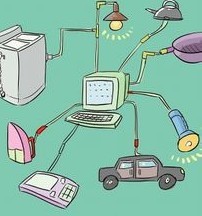
Equipping all objects in the world with minuscule identifying devices could be transformative of daily life. For instance, business may no longer run out of stock or generate waste products, as involved parties would know which products are required and consumed.One's ability to interact with objects could be altered remotely based on immediate or present needs, in accordance with existing end-user agreements.
Original definition
Ashton's original definition was: "Today computers—and, therefore, the Internet—are almost wholly dependent on human beings for information. Nearly all of the roughly 50petabytes (a petabyte is 1,024 terabytes) of data available on the Internet were first captured and created by human beings—by typing, pressing a record button, taking a digital picture or scanning a bar code. Conventional diagrams of the Internet ... leave out the most numerous and important routers of all - people. The problem is, people have limited time, attention and accuracy—all of which means they are not very good at capturing data about things in the real world. And that's a big deal. We're physical, and so is our environment ... You can't eat bits, burn them to stay warm or put them in your gas tank. Ideas and information are important, but things matter much more. Yet today's information technology is so dependent on data originated by people that our computers know more about ideas than things. If we had computers that knew everything there was to know about things—using data they gathered without any help from us—we would be able to track and count everything, and greatly reduce waste, loss and cost. We would know when things needed replacing, repairing or recalling, and whether they were fresh or past their best. The Internet of Things has the potential to change the world, just as the Internet did. Maybe even more so."
Alternative definitions
Different definitions for the Internet of Things have appeared and the term is evolving as the technology and implementation of the ideas move forward. Here are several partially overlapping definitions:
- CORDIS
- an action plan for the European Union to introduce the governance based on the Internet of Things.
- Casagras
- A global network infrastructure, linking physical and virtual objects through the exploitation of data capture and communication capabilities. This infrastructure includes existing and evolving Internet and network developments. It will offer specific object-identification, sensor and connection capability as the basis for the development of independent cooperative services and applications. These will be characterised by a high degree of autonomous data capture, event transfer, network connectivity and interoperability.
- SAP
- A world where physical objects are seamlessly integrated into the information network, and where the physical objects can become active participants in business processes. Services are available to interact with these 'smart objects' over the Internet, query and change their state and any information associated with them, taking into account security and privacy issues.
- ETP EPOSS
- The network formed by things/objects having identities, virtual personalities operating in smart spaces using intelligent interfaces to connect and communicate with the users, social and environmental contexts.
- CERP-IoT
- Internet of Things (IoT) is an integrated part of Future Internet and could be defined as a dynamic global network infrastructure with self configuring capabilities based on standard and interoperable communication protocols where physical and virtual ‘things’ have identities, physical attributes, and virtual personalities and use intelligent interfaces, and are seamlessly integrated into the information network. In the IoT, ‘things’ are expected to become active participants in business, information and social processes where they are enabled to interact and communicate among themselves and with the environment by exchanging data and information ‘sensed’ about the environment, while reacting autonomously to the ‘real/physical world’ events and influencing it by running processes that trigger actions and create services with or without direct human intervention. Interfaces in the form of services facilitate interactions with these ‘smart things’ over the Internet, query and change their state and any information associated with them, taking into account security and privacy issues.
- Other
- The future Internet of Things links uniquely identifiable things to their virtual representations in the Internet containing or linking to additional information on their identity, status, location or any other business, social or privately relevant information at a financial or non-financial pay-off that exceeds the efforts of information provisioning and offers information access to non-predefined participants. The provided accurate and appropriate information may be accessed in the right quantity and condition, at the right time and place at the right price. The Internet of Things is not synonymous with ubiquitous / pervasive computing, the Internet Protocol (IP), communication technology, embedded devices, its applications, the Internet of People or the Intranet / Extranet of Things, yet it relies on all of these approaches. The association of intelligent virtual representations (e.g.: called avatars and embedded, hosted in the Cloud or centralized) and physical objects are sometimes called "cyberobjects".Cyberobjects are then considered as autonomous actors of the value chains they are involved in: able to perceive, analyze and react in various contexts; although acting under the guidance of human beings as programmed. Cyberobjects can then be assistants, advisors, decision makers, etc.; and can be considered as true Agent (economics), helping to change existing economic or organization models. In such a scenario, the conception of avatars refers toartificial intelligence and Complex system.
Unique addressability of things
The original idea of the Auto-ID Center is based on RFID-tags and unique identification through the Electronic Product Code.
An alternative view, from the world of the Semantic Web focuses instead on making all things (not just those electronic, smart, or RFID-enabled) addressable by the existing naming protocols, such as URI. The objects themselves do not converse, but they may now be referred to by other agents, such as powerful centralized servers acting for their human owners.
The next generation of Internet applications using Internet Protocol Version 6 (IPv6) would be able to communicate with devices attached to virtually all human-made objects because of the extremely large address space of the IPv6 protocol. This system would therefore be able to identify any kind of object.
A combination of these ideas can be found in the current GS1/EPCglobal EPC Information Services (EPCIS) specifications. This system is being used to identify objects in industries ranging from Aerospace to Fast Moving Consumer Products and Transportation Logistics.
Trends and characteristics
Intelligence
Ambient intelligence and autonomous control are not part of the original concept of the Internet of Things. Ambient intelligence and autonomous control do not necessarily require Internet structures, either. However, there is a shift in research to integrate the concepts of the Internet of Things and autonomous control.[18] In the future the Internet of Things may be a non-deterministic and open network in which auto-organized or intelligent entities (Web services, SOAcomponents), virtual objects (avatars) will be interoperable and able to act independently (pursuing their own objectives or shared ones) depending on the context, circumstances or environments.
Embedded intelligence presents an “AI-oriented” perspective of IoT, which can be more clearly defined as: leveraging the capacity to collect and analyze the digital traces left by people when interacting with widely deployed smart things to discover the knowledge about human life, environment interaction, as well as social connection/behavior.
[edit]Architecture
The system will likely be an example of event-driven architecture, bottom-up made (based on the context of processes and operations, in real-time) and will consider any subsidiary level. Therefore, model driven and functional approaches will coexist with new ones able to treat exceptions and unusual evolution of processes (Multi-agent systems, B-ADSc, etc.).
In an Internet of Things, the meaning of an event will not necessarily be based on a deterministic or syntactic model but would instead be based on the context of the event itself: this will also be a semantic web. Consequently, it will not necessarily need common standards that would not be able to address every context or use: some actors (services, components, avatars) will accordingly be self-referenced and, if ever needed, adaptive to existing common standards (predicting everything would be no more than defining a "global finality" for everything that is just not possible with any of the current top-down approaches and standardizations).
[edit]Complex system
In semi-open or closed loops (i.e. value chains, whenever a global finality can be settled) it will therefore be considered and studied as a Complex system due to the huge number of different links and interactions between autonomous actors, and its capacity to integrate new actors. At the overall stage (full open loop) it will likely be seen as a chaotic environment (since systems have always finality).
Size considerations
The Internet of objects would encode 50 to 100 trillion objects, and be able to follow the movement of those objects. Human beings in surveyed urban environments are each surrounded by 1000 to 5000 trackable objects.
Time considerations
In this Internet of Things, made of billions of parallel and simultaneous events, time will no more be used as a common and linear dimension but will depend on eachentity (object, process, information system, etc.). This Internet of Things will be accordingly based on massive parallel IT systems (Parallel computing).
Space considerations
In an Internet of Things, the precise geographic location of a thing—and also the precise geographic dimensions of a thing—will be critical. Currently, the Internet has been primarily used to manage information processed by people. Therefore, facts about a thing, such as its location in time and space, have been less critical to track because the person processing the information can decide whether or not that information was important to the action being taken, and if so, add the missing information (or decide to not take the action). (Note that some things in the Internet of Things will be sensors, and sensor location is usually important.) The GeoWeband Digital Earth are promising applications that become possible when things can become organized and connected by location. However, challenges that remain include the constraints of variable spatial scales, the need to handle massive amounts of data, and an indexing for fast search and neighbour operations. If in the Internet of Things, things are able to take actions on their own initiative, this human-centric mediation role is eliminated, and the time-space context that we as humans take for granted must be given a central role in this information ecosystem. Just as standards play a key role in the Internet and the Web, geospatial standards will play a key role in the Internet of Things.
Sub systems
Not all elements in an Internet of Things will necessarily run in a global space. Think, for instance, of domotics running inside a Smart House. While the same technologies are used as elsewhere, the system might only be running on and available via a local network.
Frameworks
Internet of Things frameworks might help support the interaction between "things" and allow for more complex structures like Distributed computing and the development ofDistributed applications. Currently, some Internet of Things frameworks seem to focus on real time data logging solutions like Pachube: offering some basis to work with many "things" and have them interact. Future developments might lead to specific Software development environments to create the software to work with the hardware used in the Internet of Things. Companies such as ThingWorx are developing technology platforms to provide this type of functionality for the Internet of Things.
Applications
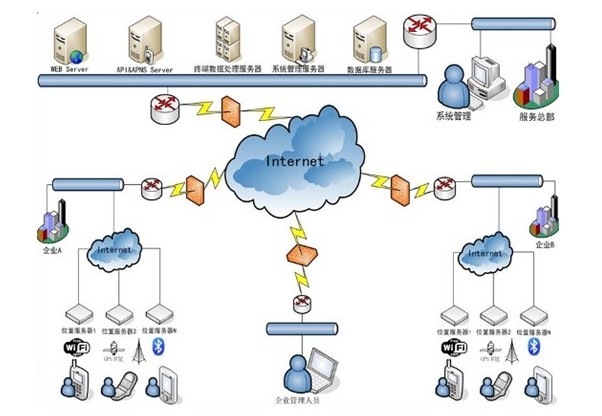
Fields of applications include for example waste management, urban planning, sustainable urban environment, continuous care, emergency response, intelligent shopping, smart product management, smart meters, home automation and smart events. Alcatel-Lucent touchatag service and Violet's Mirror gadget provide a pragmatic consumer oriented approach to the Internet of Things by which a developer can link real world items to the online world using RFID tags and QR Codes. The Connected Home offering of AlertMe is based on ultra-low-power ZigBee-enabled devices scattered around the home, which are turned into internet devices via the proxy of a home gateway. Arrayent, Inc. is a B2B company, internet-connecting consumer products (i.e. thermostats, security systems, toys, healthcare products) to smartphones, tablets, and web browsers. Pachube, built by Connected Environments Ltd, provides data management infrastructure for sensors, devices and environments, and describes itself as "a convenient, secure & scalable platform that helps you connect to & build the 'internet of things'". Nimbits, is an open source data historian server built on cloud computing architecture that provides connectivity between devices using data points. Paraimpu, is a social tool with the aim to allow people to connect, use, share and compose Things, services and devices to create personalized applications in the field of the Internet of Things.
One key issue with the Internet of Things is the ability to rapidly create IoT applications. An approach taken by the Media and Graphics lab at the University of British Columbia (Canada) focuses on a lightweight toolkit for developing IoT applications and targets rapid development using Web technologies and protocols. The toolkit has been described at the 2012 IoT (IEEE) conference and builds on previous IoT research, in particular the work on the MAGIC Broker as published at IoT 2010 (IEEE). This toolkit approach, embodied by the WoTKit has been commercialized by Sense Tecnic Systems.
MISOLIMA developed its Digital One Line Link or DOLLx8 Embedded Network system since 1991, where version 3.18 (as of 2011) is designed to address more than 28 trillion IoT objects. DOLLx8 for IoT are now due to be implemented into world first MISOLIMA eco-house system based on IoT as base technology where home, office, vehicle, alarm systems, sensors, controls and devices are all integrated into one single system.
The iDigi® Device Cloud™ allows users to connect a physical device to the cloud and use an online Web application for remote access. The application converts complex device data into simple and useful information for anyone — from business owners who want to get message when refrigerator temperatures fall below a specific threshold to farmers who want to measure soil quality. iDigi also creates Internet of Things content on their community site.
GPS NTP Time Server /SNTP Time Server (1U Rack)
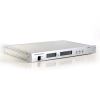
GPS/BDS Time Server(GPS & BDS sources)(Cost Effective Model)
The Bueno SY series of GPS/BDS time servers are specifically for power system, automatizatio system, communicate system and traffic system that need high-precise time requirer.Our system is based on GPS or BDS(Beidou), and the precision of time is 1µs.It can track 12 GPS satellites at the same time, and selects the best satellite automaticly for locating and timing. It outputs 1PPS, 1PPM, 1PPH time pulse and UTC time ,and the synchronous precision is 1µs, and it can measure the industrial frequency, and outputs date, time, cycle clock, cycle, clock difference, safe running days, and so on through RS232 serial with two formats. It is selected to used by automatization facilities that need standard time in electric power system.The facility adopted the technology of the united of software and hardware, and made good use of the potential of GPS receiver, so it has some characters such as high security, strong function, high precision, good proportion of capability and price, operate conveniently and so on,and it can afford to the requirement of time synchronous in electric power system,automatization system, communicate system and traffic system. With its extendly used, the development of some automatization technologies such as accident analysis, trouble range measurement and relay protection and so on will be promoted and improved greatly.
2 Technical parameter:
1. Receiving frequency:1575.42MHZ, it can track 8-12 GPS/BDS satellites at the same time.
2. Antenna radio sentivity:-166dbw, with 30 metres wire. If the wire is not long enough, customer can prolong it by himself by selection of coaxial-cable that attenuation of
1.56GHZ is not more than 0.7db per metre, the attenuation of prolonged cable is not more than 5db.
3. Capture time: from 20 seconds to 2 minutes (Annotate: the outputs of synchronous clock are all isolated by photoelectricity coupling and output 60ns)
4.1PPS output:
Timing varacity: 1µs Voltage: TTL voltage
Polarity: positive pulse Pulse width: about 100ms
Impedence: 50 Ώ Channel number: 1
Fore edge: <20ns
5.1PPM: output:
Timing varacity:: 1µs Voltage: TTL
Polarity: positive pulse Pulse width: about 100ms
Impedence: 50 Ώ Fore edge: <20ns
6.1PPH output:
Timing varacity:: 1µs Voltage: TTL
Polarity: positive pulse Pulse width: about 100ms
Impedence: 50 Ώ Fore edge: <20ns
7.Cycle precision: ±0.001
8.Industry frequency clock: the clock that is promoted by industry electricity is synchronous with standard clock when power is on.
9.Clock difference: that is standard clock minus industry frequency clock,synchronous time difference is zero,precision is 20 ms.
10.Longitude, latitude: where the electric power synchronous clock locates.
11.Display: 14 bits LCD display that includes cycle,date,time,longitude,latitude,industry frequency clock,clock difference (standard clock minus industry frequency clock).
12.RS232: output time code (year, month, day, hour, minute, second), industry frequency clock time(hour, minute, second), clock difference,cycle.
13.RS232: output “ST” format time code (selected by switching circuitry)
14.Power: DC110V, 10%, 15W. AC or DC other power supply is also accepted.
15.Size: standard 1 U Chasis.
16. Support Redundant GPS timing systems.
17. Optional output connectors: RJ45,DB9,Seral 485 terminal,Irig-B, BNC,Fiber ST & all other types of connectors.
Ordering information:
|
Model |
Technical Parameters
|
Comment (Optional dual power) |
|
SY-GPS-2-G |
2 channel 1 PPS,2 channel 1 PPM , 1 channel 1 PPH (TTL/ active optical isolation and passive) 4 channel RS232, 2 channel RS485 (serial code) 2 "RS485 (IRIG-B (DC) difference), lose electric/out-of-step alarm to the 2 With expand output interface (can direct drive extension device)
|
Ac/dc power supply terminals wide input Optional NTP and optical output
|
|
SY-GPS-2-E16 |
2 channel 1 PPS,2 channel 1 PPM , 1 channel 1 PPH (TTL/ active optical isolation and passive) 4 channel RS232, 2 channel RS485 (serial code) 16channel"RS485 (IRIG-B (DC) difference), lose electric/out-of-step alarm to the 2 With expand output interface (can direct drive extension device)
|
Ac/dc power supply terminals wide input Optional NTP and optical output
|
|
SY-2U-TIME SY-2U-GPS-CPU X1 SY-2EX-IRIG-B(DC) X1 |
12 "RS485 (IRIG-B (DC) difference), lose electric/out-of-step alarm to the 2
|
2Uchassis Can be expanded plug-in |
|
SY-GPS-2-E32 |
2 channel 1 PPS,2 channel 1 PPM , 1 channel 1 PPH (TTL/ active optical isolation and passive) 4 channel RS232, 2 channel RS485 (serial code) 32 "RS485 (IRIG-B (DC) difference), lose electric/out-of-step alarm to the 2 With expand output interface (can direct drive extension device)
|
Ac/dc power supply terminals wide input Optional NTP and optical output
|
|
SY-2U-TIME SY-2U-GPS-CPU X1 SY-2EX-IRIG-B(DC) X3 |
32channel"RS485 (IRIG-B (DC) difference), lose electric/out-of-step alarm to the 2 |
2U chassis Can be expanded plug-in |
|
SY-GPS-2-FS16 (PPS OutPut) |
2 channel 1 PPS,2 channel 1 PPM , 1 channel 1 PPH (TTL/ active optical isolation and passive) 4 channel RS232, 2 channel RS485 (serial code) 2 "RS485 (IRIG-B (DC) difference), 16 channel 1 PPS / 1 PPM high-pressure high-speed photoelectric isolated active and passive output lose electric/out-of-step alarm to the 2 With expand output interface (can direct drive extension device) |
Ac/dc power supply terminals wide input Optional NTP and optical output
|
|
SY-GPS-2-FM16 (PPM ,Pulse Per Minute Output) |
|
|
|
SY-2U-TIME SY-2U-GPS-CPU X1 SY-2EX-1PPS/1PPM X1 |
12 "RS485 (IRIG-B (DC) difference), , lose electric/out-of-step alarm to the 2
|
2U chassis
|
|
SY-GPS-2-FS32(PPS Output) |
2 channel 1 PPS,2 channel 1 PPM , 1 channel 1 PPH (TTL/ active optical isolation and passive) 4 channel RS232, 2 channel RS485 (serial code) 2 "RS485 (IRIG-B (DC) difference), 32 channel 1 PPS / 1 PPM high-pressure high-speed photoelectric isolated active and passive output lose electric/out-of-step alarm to the 2 With expand output interface (can direct drive extension device) |
Ac/dc power supply terminals wide input Optional NTP and optical output
|
|
SY-GPS-2-FM32 (PPM ,Pulse Per Minute Output)) |
|
|
|
SY-2U-TIME SY-2U-GPS-CPU X1 SY-2EX-1PPS/1PPM X3 |
36 "RS485 (IRIG-B (DC) difference), , lose electric/out-of-step alarm to the 2
|
2U chassis |
|
SY-GPS-2-NET |
2 channel 1 PPS,2 channel 1 PPM , 1 channel 1 PPH (TTL/ active optical isolation and passive) 4 channel RS232, 2 channel RS485 (serial code) 2 "RS485 (IRIG-B (DC) difference), lose electric/out-of-step alarm to the 2 With expand output interface (can direct drive extension device) 2 "NTP/TCP network time output
|
Ac/dc power supply terminals wide input. Optional fiber optical output
|
USB to Zigbee Wireless Gateway
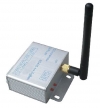
USB to Zigbee Wireless Gateway/Module/Converter(BUE-ZIG-USB)
Detail description:
BUE series of USB to Zigbee wireless serial communication device, using the Zigbee wireless technical, is compliance with the industrial standard. It has advantages of long communication distance, strong anti-jamming, flexible network to make sure transparent data transmission among many devices with self-organizing star, line and mesh network topology.
Performance:
Long communication distance: maximum 1500m at sight
Strong anti-jamming function: 2.4DSSS
Flexible serial application: transparent format or instruction format, maximal baud rate 115200
Flexible node type: coordinator node, router node or end device (optional)
Strong network function: star, tree, line, mesh
Big network capacity: 16channels for choosing, 65535 network ID to be set
Technical parameter
Wireless Protocol: Zigbee2007/PRO
Wireless frequency: 2400-2485m 2.4 ISM free frequency range
Channel: 16channels
Channel detection: CSMA/CA
Antenna rate: 250K stable
Networking construction: star, line, tree, mesh
Network capacity: 65535
Transmission type: broadcast or target address to send
Input voltage: DC5V
Average power consumption:0.6W
Transmit power output: 25dbm
Baud rate: bit rate 1200-115200 optional
Standard accessories: 3dBi glue stick antenna, data wire and the USB driver.
Optional accessories: suction cup antenna with extended cable
Work Temperature: -20-70C