
Sidebar
News Press

Administrator
The Electric Industry Development of Vietnam & Malaysia
Vietnam
Vietnam national power installed capacity of 8.86 million kilowatts, 2002 new installed capacity of 633000 kilowatts, an increase of 7.69%. Hydropower accounts for 47.26% of the total installed capacity. Have a state power company.
Vietnam electricity 35.8 billion KWH, 2002 growth of 16.96%. The 30.26 billion KWH electricity. Average annual growth rate of 15.9% since 1995. 2002 sell electricity income 22.349 trillion Vietnamese dong ($1.458 billion), profits 1.844 trillion Vietnamese dong ($120 million).
1. The Vietnam national electric power company
Vietnam national electric power company (ELECTRICITYOFVIETNAM, EVN) is a concentration of power generation, transmission and power supply in the integration of state-owned power enterprises, 93% of the nation's power capacity and all belong to EVN substation and power grid.
EVN in addition to the functions of the management and staff of 14 plants, four regional power grid companies, 7 electric power company, the national load dispatch center, electric power communication company, four engineering consulting firms, power training schools and independent institutions such as electric power equipment manufacturing company.
(1) EVN transmission conditions
Vietnam grid has 500 kv, 220 kv, 110 kv transmission voltage grade three. There are four regional power grid. The dispatching system is divided into national dispatching center, regional dispatch center and distribution dispatching center.
Due to historical reasons, Vietnam's distribution network composed of all kinds of voltage grade. Urban and rural power distribution network run by seven electric power company. The power supply line loss.suggestions in 2002 was 13.41%. Vietnam's industrial and MinYongDian main part of the total electricity consumption, 42% and 48%, respectively.
(2) EVN research and development status
EVN equipped with energy research institute, but more focused on energy policy research, there is no specific technology research and development institutions. EVN to realize electric power development is also need to set up a corresponding technology research and development institutions, has now launched by high pressure test.
EVN pay close attention to the application of information technology, information center has become a key management entity of the EVN. And it is in the United States, the world bank and SIDA (Sweden) and other funding, EVN have established financial, customer, customer service management information system. Is currently in power generation, transmission, distribution, operation, maintenance, and other fields to establish unified company management information system. Communication is one of the important services EVN. With international and domestic communications services license issued by the government, including fixed phone, VOIP, line rental, INTERNET access and exchange services. EVN in communications services goal is to become the domestic biggest telecom service providers.
(3) the EVN financial situation
EVN2002 in net worth of $2.207 billion, $1.5 billion, $95 million net profit, net profit margin of 6.3%.
2. The Vietnam electric power development plan
Vietnam is to strengthen the construction of power grid, from now to 2010, the new 14524 km transmission line, the new 3826.5 kva substation capacity, including the second 500 kv lines were under construction.
To improve the reliability of power transmission and distribution, reduce the line loss, improve the quality of electric power transmission and distribution, investment to repair and expand and update the distribution network, line loss.suggestions reduced to 10% by 2010. By 2010, the new low voltage line length of 282714 km and 1901 kva substation capacity.
Strengthen investment, financing, and attracting foreign investment for electric power construction, efforts to achieve between $1.5 billion and $2 billion each year, domestic and international financing, in order to meet the annual average of 15% ~ 16% of electricity demand growth needs. Encourage investors to construction of IPP and BOT power plants. By 2010, Vietnam is planning to build 32 EVN power plants and 89 IPP, BOT power plants, a total investment of about $10 billion.
3. Vietnam electricity technology needs
Vietnam electric power development at present the main problem is: in northern Vietnam electric capacity shortage; Load the rapid growth of demand; Big peak valley difference; Power grid reliability and stability of the problem; The power supply line loss is bigger; The large capacity power problem; International coordination problems (with China) connected to the technical standard, and the corresponding control measures.
Vietnam electricity technology needs mainly include: improve the level of power grid, power plants, substation control standards and, if establish unattended substation, etc.; Need to analyze the development and operation of the whole system and research; Set up a corresponding technical standards; EVN prepared to set up some research institution, to research the problems in power system, is the preparation of the high pressure experiment, the need for technology and staff training; In 2010 in central Vietnam planning in nuclear power plant construction, the cultivation of the technical cadres, training and financing aspects of the work is under way.
Vietnam in electric power construction, many problems existing in the production and operation, is an urgent need to communicate with experts and technology of China, learning experience and technology of China.
4. Pay attention to and to solve problems
Vietnam is a country with a developing rapidly in recent years, the economic growth rate is higher, electric power development speed is faster. Vietnam national and EVN are ambitious to the development of electric power, full of confidence and hope in all aspects of the electric power construction. In addition to electric power construction and operation, but also very concerned about communication, information, manufacturing, technical research and development and so on many aspects. But in the process of development, Vietnam also faces many problems need to be solved and difficulties, including financing, the construction of the new project, security and stability and economic operation of power system, such as the technical problems in technical cooperation for the power system in China and Vietnam have created good conditions and output.
Vietnam is an urgent need to solve the problem of long distance transmission of power grid stability. Vietnam has a north-south 500 kv lines more than 1500 kilometers long, is building another 500 kv lines more than 2400 kilometers long, its frequency and voltage stability problems will have to face and solve.
Vietnam is an urgent need to enhance the level of its electric power equipment. In addition, Vietnam and China southern power grid network, also need to satisfy the operation requirements of China power grid.
EVN is very attention to the technical standard. With the expansion of the power grid and power, opening-up and cooperation, the establishment of technical standards is very urgent for electricity. Hope to be able to close cooperation with China in the field of standardization.
Vietnam's problems at present, China will be able to provide a good solution, but Vietnam aspects of China's specific technology and the ability to understand enough, communication channels are not very clear. So, it is necessary in both sides more to increase communication.
Malaysia
Malaysia grid consists of west Malaysia grid power grid and east Malaysia, east Malaysia and west by the south China sea apart, more than 600 km. In 2002, the installed capacity of 14.024 million kilowatts.
Malaysia's power system by the national electric power company (TENAGANASIONALBERHAD, TNB), sand and waterlogging, the power companies and independent power generation companies. West Malaysia grid by the national electric power company management in Malaysia, and Singapore and Thailand connected to the grid. East Malaysia grid is composed of the sand waterlogging and sabah electric power company, sabah power company owned by the state power company. East Malaysia and west Malaysia grid has not been connected to the Internet.
1. The state power company in Malaysia
Malaysia was established in 1949, the central electricity board, 1965 to the national power authority, in 1990 changed to state power company (TNB). TNB is one of the largest companies, Kuala Lumpur stock exchange capital market value of about 29 billion ringgit ($7.6 billion), the net worth of us $3.1 billion. TNB have power generation, transmission and distribution.
TNB as a big power company, widely involved in the business field, in addition to prop up its power generation, transmission and power supply necessary for the core business of professional technical and engineering institutions, companies, also in the financial, communications, and manufacturing investment, also have independent research and a university. TNB2002 years revenues of $4.046 billion, $298 million net profit, net interest rate of 7.4%. Malaysia the installed capacity of 14.02 million kilowatts, the TNB is 9.1482 million kw, accounted for 65.3%.
(1) the TNB transmission conditions
Is one of the core business of TNB transmission business, from design, engineering, operation and dispatch to the maintenance of the system, overall responsibility for power grid operation of the west Malaysia.
TNB transmission system across the whole peninsular Malaysia (west), combined with all power plants and users, with 132 kv, 275 kv and 500 kv constitute the national grid.
State grid interconnection in the north, the south and Thailand power bureau, through two submarine cables are connected to the power system in Singapore.
(2) the TNB power status
Peninsular Malaysia (west Malaysia) power generation by TNB and independent power suppliers (IPP), independent power suppliers and TNB electricity purchase contracts.
TNB also in Pakistan has installed 235000 kilowatts of independent power generation companies. The subsidiary sabah power company in east Malaysia sabah also USES power purchase contracts for electric power marketing.
TNB power plant is mainly composed of thermal power and hydropower. Coal-fired power plants using conventional steam turbine, power plant using runoff and capacity of hydropower station. In addition to buy power from its own plant and independent power suppliers, TNB also to buy power from Thailand and Singapore to meet peak demand.
(3) the TNB research and development situation
TNB is equipped with a wholly-owned institute, the name (TNBR) for TNB research company, a former national power authority departments, mainly to undertake research and development work of TNB. TNB to TNBR r&d funding, every year for more than year sell electricity, on the basis of per KWH electricity 0.1 ringgit (about 0.0263 cents). Calculated at TNB quantity sold in 2002, research and development funds of about $16.72 million in 2003. TNBR are involved in the research and development power generation, transmission, distribution, environmental protection, etc.
2. Power technology requirements in Malaysia
Malaysia counterparts very focus on the relevant technical problems of power grid dispatching, they are very honest introduced several major blackouts in Malaysia, and put forward a series of technical problems, hope for further communication and discussion with us. These technology problems include: voltage control problem; System dynamic stability (buckling) problem; Overhead line, cable and transformer overload; Power line lightning protection, fault location and line lightning arrester; The transient fault record, etc.
3. Pay attention to and to solve problems
Malaysia is a good country rich in resources, economic development, to the requirement of electric power system safe and stable and reliable power supply is very high. TNB is the national electric power company, is also a shares of the listed company, so for the high demand for electric power operation technology and management technology, the demand is urgent.
Because the total grid capacity is not big, Malaysia and east horse and west separately, with Singapore and Thailand's power contact is not very close, there are a number of problems with power grid stability. Grid stability accident to happen from time to tome, national blackout happened in 1996, power grid solutions listed accidents happened in 1998. So they are very concerned about the problem of stability of power grid and are keen to technical communication with China.
TNB have relatively complete system of power generation, transmission, distribution, maintenance, but many of the techniques and equipment is not able to fully meet the needs of power system operation and management, a lot of work need to use external resources.
TNB large capacity equipment needs to be imported from abroad, the basic needs of high technology to control the electric equipment imports. Because of the blackout accident in recent time, Malaysia is to evaluate the applicability of the western equipment. Malaysia colleague also noted that China's vast power grid running in good condition, so the electricity control equipment in China, especially in high pressure and ultrahigh pressure relay protection equipment is very very attractive to them.
Wind Farm Development Analysis
Installing a wind farm includes a number of jobs and also the recruits originate from diverse skills who're useful for industries for example construction, consultation, operation and maintenance, sells services, finances, technical department and planning and development. People who would like to continue with design and searching if this involves devising technology for wind farm technologies may also be prepared to be compensated.
Solutions to Wind Power jobs include search for various sites and identifying the very fact whether or not they are appropriate for the making of the farms. The assessment is created based on various factors for example community support, local power grid infrastructure, land possession issues, existence of logistical support and meteorological modelling. Site engineers are utilized for this function.
The Eastern Chesapeake Bay is really a preferred place for off-shoreline wind farms. These farms happen to be situated offshore using the oilrigs which have been around for many years. For that bigger wind farms which are been built, a larger emphasis is positioned on logistical support needed for moving the heavy installations and components.
Acquiring finance choices for the wind farms is another challenging task and must be taken care off different color leaves as technological enhancements. New financing options happen to be produced that imply that you could payback the total amount on the longer duration. Alternative Energy Certificate schemes can be found for producing the revenues. This forms an important facet of Wind Turbine Generator System.
The expertise of researchers and ecologists will also be needed if this involves installing RE or alternative energy installations. The neighborhood atmosphere conditions have to be considered and for that reason individuals engaged in the process of environment impact assessment need to have a tab from the Wildlife Conservation Functions and bigger worldwide environment contracts before acquiring consents for installing the plants.
Another facet of wind farm development jobs would be to transform a planning application to some concrete project. The website must be reasonably selected and also the needs from the project effectively conveyed towards the team. Understanding from the local governmental rules is as essential as technical knowledge of the work.
Industrial Media Converters Palying More Roles In Security Systems
Industrial Media Converer in Video Security and Surveillance Systems
Typical Video Security Applications
Analog Video Systems
IP Video Systems
Benefits of Using Industrial Fiber Optics in Video Security and Surveillance
How Media Conversion Can Ease the Transition to Fiber
Video security and surveillance has become increasingly important the last few years, not only as a topic of conversation, but also as a corporate and government strategy reality. Whether retailers are monitoring for shoplifting or employee theft, corporations identifying visitors and employees or monitoring hazardous work areas, governments and municipalities combating street crime and terrorism, casinos preventing cheating and fraud or even homeowner’s protecting their families and assets, one cannot deny the benefits of an effective video security system.
In recent years, demand for these applications has increased and technology has advanced so rapidly that there are now a myriad of choices among components. In fact, when one looks only at cameras, we can find many models, each with a specific use for time of day, fixed or pan, tilt and zoom (PTZ) capability, resolution quality, analog or IPbased video, etc. Unfortunately, one common component that is often overlooked in video systems is the quality of the cabling infrastructure used to transport these video images from camera to monitor or from camera to storage device. Designing your video network around coaxial, un-shielded twisted pair (UTP) or fiber-optics will have tremendous impact on the quality, bandwidth and distance capabilities of your video security and surveillance system.
Typical Video Security System
Whether the video surveillance is analog-based or IP-based, there are a number of common components to most video systems including cameras, cabling infrastructure, monitors and a means of recording the video for future use and playback. Let’s take a quick look at two of the most common video systems in use today.
Analog Video Systems

Closed-circuit television (CCTV) systems have been in use for more than twenty years and comprise the vast majority of video security systems in use today. In a typical CCTV system analog cameras are connected via coaxial cabling back to a central management room where the coax is connected to a monitor(s) and a video cassette recorder (VCR) or digital video recorder (DVR) An additional component called a controller is used if the cameras have PTZ capability and is generally centrally located. All components are dedicated to this CCTV system and the system is “closed” to external access.
(click for larger view)
Fig. 1: Analog Video Security System with fixed and PTZ cameras
IP Video Systems

IP-Surveillance systems are relatively new to the market. In a typical IPbased video surveillance system, network (IP) cameras are connected directly to the Local Area Network (LAN) and transport digital video across the IP network via UTP cabling and switches, recording video to any PC or server on the network. Since the cameras are IP addressable, they are able to be accessed from anywhere in the world, provided the user has the sufficient network access and security privileges.
(click for larger view)
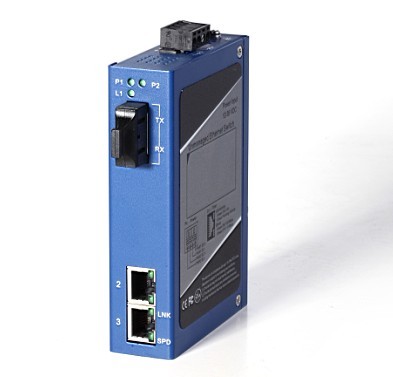
The Ethernet Media converters will play more and more roles in Video surveillance systems with the increasing application of IP cameras. The IP cameras are partly mounted outdoors or hot places,where the commercial fiber media converters will break down or stop working directly because of high heat. The invention of Industrial Fiber Media converter solved this problem,which will work normlly in these harsh places and it will be the trend of IP video systems in the future.
Fig. 2: IP Video Security System

Benefits of Using Fiber Optics in Video Security and Surveillance
In the ever increasing reach of today’s video security and surveillance systems, many security professionals are finding that the quality, bandwidth and distance needed to perform even the most basic surveillance is beyond the reach of coaxial and UTP cabling. In fact, even though IP-based video security systems are gaining popularity, they face a serious distance limitation of 100 meters (328 feet) or less over UTP cabling infrastructure. This poses an insurmountable hurdle when trying to monitor the many outreach locations of a typical surveillance installation. While fairing slightly better in copper distance limitations, most analog-based CCTV systems prove effective and economical only if the coaxial cabling runs are held to less than 750ft (228m). Utilizing coax beyond that distance, however, poses a number of problems, some of which are not immediately obvious.
For instance, let’s say your monitor is located 1,000 ft (304 m) from the camera. In that scenario, without any active signal conditioning, approximately 37-percent of the high frequency information will be lost in transmission, providing a seriously degraded image. In fact, since you cannot see information that is not there, you may not even realize that information has been deleted. To accommodate lengths greater than 750 feet (228 m) on a coax infrastructure, you must make certain that some provision has been made to guarantee the video signal's transmission strength such as the use of signal amplification, ground fault correction and surge protection. Installing these items will inevitably increase the cost of the system considerably, making alternative cabling methods more attractive.
In fact, the use of fiber optic cable will allow for cable runs of over 1500 meters (5,000 feet) on multimode and distances of over 10km (6.2 miles) on single mode cable. In addition to distance extension, fiber optics also presents a number of other unique benefits not present in either coax or UTP cabling:
•Smaller size and better tensile strength making it easier to install when pulling through conduit or in overhead cable trays
•High degree of security as fiber is inherently difficult to tap into or interfere with
•Immunity to electrical interference such as:
◦Electromagnetic interference (EMI)
◦Radio frequency interference (RFI)
◦High voltages found in fluorescent lights, card access door strikes and outdoor lighting systems
◦Induced voltages (ground loops) which causes picture distortion and audio interference
•Higher bandwidth
•Improved reliability and overall transmission performance
Local area networks (LANs) very commonly deploy fiber optics as the network backbone between buildings or in vertical risers of multi-story buildings. Utilizing this infrastructure already in place would be an attractive transmission alternative to risking the distance and quality issues common to coax and UTP video systems. Accessing this fiber optic cabling can be a challenge for most video security professionals as the majority of new cameras and monitors on the market today are not available with fiber optic ports on them. In addition, most existing video security and surveillance systems were designed and installed with coax or UTP cabling. To improve the quality, bandwidth and distance of these existing systems by transporting the video on fiber optic cabling, a method is required to convert the electrical video signal over to an optical format.
How Media Conversion Can Ease the Transition to Fiber
For those not familiar with the technology, media conversion products transparently connect one type of media, or cabling, to another – typically copper to fiber. Bridging the gap between legacy copper infrastructures and fiber growth, media conversion products provide an economical path towards extending the distance of an existing network, extending the life of non-fiber based equipment, or extending the distance between two like devices.
Whether distance extension or simply utilizing existing fiber optic infrastructure, media conversion can be a cost-effective way to integrate fiber optic cabling into an existing copper-based video security system. In addition, the video media converters can be designed to actually perform many other functions in addition to transporting the video signal over fiber optics such as transporting the serial information necessary for control of PTZ cameras or even providing a means to transport the video over the Ethernet-based LAN. Below is a list of commonly found media conversion products listed from the most basic features to more complex products:
Analog video conversion
•Video baluns (passive) – un-powered devices that convert the video signal on coaxial cabling over to UTP cabling
•Video baluns (active) – powered devices that convert the video signal on coaxial cabling over to UTP cabling plus provide signal amplification and equalization
•Analog Video Media Converters – powered devices that convert an analog video signal on coax over to a fiber optic medium
•Analog Video + Data Media Converters – powered devices that convert an analog video signal on coax over to a fiber optic medium plus provide transport of serial data for remote control of PTZ cameras
•Video Encoders/Decoders (Codec) – powered devices that convert an analog video signal on coax over to an IP formatted signal that can be transmitted onto an Ethernet compliant fiber optic medium
IP video conversion
•Ethernet Media Converters – powered devices that convert an IPbased video signal on UTP over to a fiber optic medium
•Power over Ethernet (PoE) Media Converters – powered devices that convert an IP-based video signal UTP over to a fiber optic medium, as well as inject the power onto the UTP necessary to power remote IP cameras
Media converters come in a variety of form factors and sizes ranging from miniature, stand-alone devices that attach directly to a camera to managed, chassis-based devices allowing for full SNMP monitoring and management of the media converters.
In addition to providing a means for transparently connecting one type of media to another, media conversion can provide a cost-effective method for integrating a hybrid video security and surveillance system into one, seamless and manageable entity. Imagine the cost savings that can be realized by utilizing an existing, analog-based CCTV infrastructure, while implementing the latest technology of IP-based cameras for specialized video capture, storage or analysis as well as additional surveillance locations.
Fig. 4: Hybrid Video Security System with Media Conversion
The scope of this white paper is not to debate the merits of analog vs. IPbased video security systems or even to make claim that a hybrid solution is best, but rather to draw your attention to what often times can be the weakest link in many video applications – cabling infrastructure. While coaxial, UTP and fiber-optic cabling each have definite benefits making them the optimum choice for a given installation, designing the cabling infrastructure does not need to be limited to the connector available on the output of a camera or input to a monitor or storage device. Media conversion can provide an economical and effective means to convert to the cabling medium of choice for the best performance, highest bandwidth or greatest transmission distance needed to provide for an optimal video security and surveillance system.
Know-how of Industrial Ethernet Switch's Security
DHCP control technology
DHCP Server can automatically set the IP address for the user, mask, gateway, DNS and WINS network parameters, such as solving client changes (such as a laptop or wireless network) and the IP address of the client number more than can be allocated, simplifying the user Settings, improve the efficiency of management. But on using DHCP management, there is a DHCP Server pretend, Dos attack of DHCP Server, the user to specify the IP address which brings the problems such as network address conflict.
1. Layer 3 switches the DHCP Relay technology
Early DHCP protocol is only applicable to the DHCP Client and Server in the same subnet, not can work across a network segment. Therefore, in order to realize the dynamic host configuration, it is necessary to set up a DHCP Server for each subnet, this is clearly not the economy. The introduction of the DHCP Relay to solve this problem: DHCP Client can use DHCP Relay in LAN with other subnets DHCP Server communication, finally get the IP address of the legal. In this way, multiple DHCP Client on the network can use the same DHCP Server, saves cost, and convenient for centralized management. The DHCP Relay configuration includes:
(1) configuration of IP addresses
In order to improve the reliability, can be set on a network segment, for the DHCP Server. Master, the DHCP Server form a DHCP Server group. Master, can use the following command to specify the IP address of the DHCP Server.
In the system view under the following configuration:
DHCP - server IP groupNo ipaddress1 [ipaddress2]
(2) configuration VLAN interface corresponding group
Under the VLAN interface view the following configuration:
The DHCP server groupNo. -
(3) can make/DHCP security features on the VLAN interface is prohibited
Enable DHCP on the VLAN interface security features will start the VLAN interface under the legality of the user address check, so we can put an end to the user to configure IP address disturb the order of the network, with the DHCP Server, rapid, accurate positioning virus or interference sources.
Under the VLAN interface view the following configuration:
Address - check the enable
(4) configuration user address table entries
In order to make the configuration of DHCP Relay legally fixed IP address within the VLAN users will be able to address legitimacy through the DHCP safety check, you need to use this command to a fixed IP address users to add an IP address and MAC address of the corresponding relationship static address table entry. If there is another illegal user configured with a static IP address, the static IP address and legitimate users of fixed IP address conflict, perform the function of DHCP Relay Ethernet switch, can identify the illegal users, and refused to illegal user IP and MAC address binding request.
In the system view under the following configuration:
DHCP ws-security static ip_address mac_address
2. Other address management technology
On the layer 2 switch, users can obtain through legal DHCP server to obtain IP addresses, DHCP Snooping - security mechanism allows for the ports are set to trust and distrust port. The trust ports connect to a DHCP server or other switches; Don't trust port connection user or network. Distrust port will receive DHCP server response DHCPACK and DHCPOFF packet; And trust port will be the normal DHCP message forwarding, so as to ensure the user to obtain the IP address of the right.
(1) the on/off switch DHCP Snooping function
By default, Ethernet switch function of DHCP Snooping - closed.
The following configuration under the system view, to enable the DHCP Snooping function:
DHCP snooping -
(2) port for trust port configuration
By default, the switch ports are suspicious of port.
Under the Ethernet port view the following configuration:
DHCP snooping - trust
(3) to obtain IP address through DHCP configuration VLAN interface way
Under the VLAN interface view the following configuration:
DHCP - alloc IP address
(4) access management configuration, the configuration/IP address/port MAC address binding
Can use the following command to the Port, IP address and MAC address binding together, support the Port + IP + MAC, Port, the Port + IP + MAC and IP + MAC binding way, prevent to remove machine equipment or abuse of MAC address, IP address embezzlement attacked, etc., but this method huge effort.
The Relay Protection ff Distribution Transformer
The relay protection of distribution transformer
1 Distribution transformer should be configuration of relay protection:
(1) low voltage side of transformer should be installed with short circuit protection and overload protection. Short circuit protection as main protection of busbar protection, main transformer, and as the backup protection of distribution line.
(2) the low voltage side of transformer main protection should be with high side and low voltage power distribution line protection has good selectivity, and ensure the system normal peak current (such as motor starting current) does not cause the protection misoperation.
(3) the low voltage side of transformer main protection can also double as single phase earthing protection, can be used with single-phase grounding protection of low voltage circuit breaker for the low voltage side of transformer main protection (e.g., DW16 type low voltage circuit breaker), such as when sensitivity is not enough, should add zero sequence protection.
(4) to get action time cooperate and line protection, the low voltage side of transformer short-circuit protection generally USES the instantaneous or short time delay tripping device moves to disconnect circuit breaker on the low voltage side, over load protection with long time delay tripping device to low-voltage circuit breaker or to send out alarm signals on duty personnel.
2 power distribution line main protection:
(1) low voltage power distribution lines shall be installed with short circuit protection, overload protection and earth fault protection. In the failure to cut off the power supply or signal alarm.
(2) installed with short circuit protection device of distribution circuit, at the end of the protected line: neutral directly grounded system of single phase short circuit, protection device must be action as soon as possible (for the action time of the fixed electrical equipment is not more than 5 s) removal of the fault.
3 the protection of the ac motor:
In order to protect the ac motor coil turn-to-turn short circuit, grounding and overload, ac motor should be installed and short circuit protection, and installed according to the specific situation ground-fault protection, overload protection, and phase failure protection. Electric hunger of short circuit protection, appropriate USES fuse or with snap or short time delay tripping device of low voltage circuit breaker; The important motor for individual capacity is bigger, also can be used over current relay on the low voltage circuit breaker. The points mentioned below.
(1) Short circuit protection:
Interphase short circuit occurred when the motor terminal locations and when one-phase ground fault in neutral directly grounded system, protection device should cut off the fault as soon as possible. When the normal starting of the motor and self-starting, short circuit protection device should not be wrong action. Therefore, the rated current of the fuse melts meter namely deviation should be based on the Ann s characteristic curve after slightly higher than the intersection of motor starting current and starting time to select, but shall not be less than the rated current of the motor. To snap the overcurrent trip or relay setting current preferable starting current of the motor cycle component of 1.7 to 2 times to avoid the influence of the aperiodic component when starting current. Consisting of low voltage circuit breaker and contactor electric main circuits, when the short circuit current is greater than the contactor "bounce off the current" (the contactor contact bounce off automatically by electric current), even if low voltage circuit breaker in the contactor disconnect before release, but in the contact arc time contact will bounce off due to the effect of short circuit current electric power so that a strong arc, burns contact, produce fusion welding, make the contactor can't continue to work. In this case, the operation is not frequent motor, can use rapid movements of low-voltage circuit breaker or in low voltage circuit breaker with electric operator instead of the protection circuit of low voltage circuit breaker and contactor; Motor for frequent operation, as far as possible put contactor in the end of the main circuit, to reduce the contactor after short-circuit current, make it less than "bounce off the current".
Ac motor short-circuit protection appliances should be installed by following regulation: every electric made respectively installed with short circuit protection, but when the total number of electric motor current is not more than 20 a is calculated and allow indiscriminately, cut off or on craft a set of motor is closely related to a short circuit protection appliances can be Shared. At this point, the short circuit protection should be with the lateral load control electrical appliances and motor overload protection appliances. Short circuit protection and make ground fault protection, should be in each earth-free climbs. Short circuit protection for phase short circuit protection, only fuse should be in each earth-free climbs, overcurrent trip or relay shall be installed at least two terms.
(2) the ground fault protection
Ac motor of earth fault protection shall be installed according to the following:
The power method is used to make indirect grounding protection, each electric made respectively installed ground fault protection, but when sharing a set of a set of motor short-circuit protection appliances or allow indiscriminately, to cut off the secondary end of the line, a set of several electric motor can be Shared a ground-fault protection appliances.
The setting of earth fault protection shall be the grounding system type and fault loop impedance values. When earthing fault occurring in addition to meet the requirements of the thermal stability, should also cut off the fault circuit quickly, make within the duration of the fault voltage danger will not cause personal casualty and electrical fire accident getting an electric shock.
(3) the overload protection
Ac motor overload protection shall be installed according to the following:
Easy to overload in the operation of the motor and starter or since starting harsh and calling for a restriction on the starting time of electric motor, should be installed over load protection, continuous operation of the electric made furnish overload protection. Overload protection generally delay action in power off.
Short-term job or intermittent cycle of the motor, can not installed over load protection, but may occur in the operation of the locked-rotor, shall furnish locked-rotor protection. Suddenly loses power will lead to more losses than a load motor, should not be installed over load protection or overload protection in the signal.
Overload protection appliances generally adopt thermal relay or over-current trip, over-current relay may be adopted. For a large ac motor when conditional still can use temperature protection, or other appropriate protection.
Overload protection action characteristic of electrical appliances should be made to match the motor over load characteristics. When the motor running, or the normal starting since the start, protection appliances should not be wrong action.
(4) open phase protection
Ac motor open phase protection, should be installed by following regulation: continuous operation of the three-phase motor, with the fuse protection should be installed when open phase protection, open phase protection with low voltage circuit breaker protection of installations. Short-term job or intermittent cycle power rating is not more than 3 kw motor, don't furnish phase failure protection. Phase failure protection appliances generally adopt open phase protection of thermal relay, current production of motor protection switch, mostly with phase failure protection device.
4 Common relay protection device
In the applications of low voltage power distribution system relay protection device is very much, have a low voltage circuit breaker, fuse and various protective relay. The following main analysis of low voltage circuit breaker and residual current protective device.
(1) low voltage circuit breakers
Circuit breaker for low-voltage distribution system, according to the installation category is divided into levels the power level of universal circuit breaker and power distribution circuit breaker, power distribution circuit breaker is divided into power distribution and motor protection type two kinds, the use of these two kinds of circuit breaker condition is different, its protective properties also have bigger difference. Choose the main technical parameters of distribution protection and motor protection circuit breaker: is the difference between the instantaneous current setting of the former is 10 times that of the latter is 12 times. Motor protection circuit breaker long time delay of the overcurrent trip in 7.2 times setting electricity flow action time should be greater than the actual starting time of motor. For the universal circuit breaker CCW1 technology parameter selection more convenient. Its current and time parameters after the setting values given are adjustable sizing, parameter selection is more accurate.
(2) The residual current protective device
(Residual current Protective Device(RCD), often referred as leakage protector or leakage switch. Installed in the low voltage power distribution system is the residual current protective device is one of the effective measures to prevent electric shock accidents, and prevent the damage caused by residual current electrical fire and electrical equipment the technical measures of the accident. Should install residual current protective device and other various technical measures to prevent electric shock, such as automatic cut off the circuit, grounding, equipotential connection, etc.) at the same time. To make selective leakage protection devices should be based on the principle of grading protection, make the end of the end and power leakage protection device characteristics. Generally, according to the specific circumstances, can be divided into two to four levels of protection. At the same time, the protection between the action value and time value at various levels shall cooperate with each other.
Unlike general protection, leakage protection using graded protection should be based on the terminal protection, power supply side chooses low sensitivity of current value, to protect the action time lag between higher and lower should not be less than 0.2 s.
Shanghai Electric Got 9 Overseas Projects
Shanghai Electric has successively built nine overseas projects,which accounted for nearly 20% volume of their turnover.
In the northwest of the Indonesian resort island of Bali, a group of employees from Shanghai electric power construction co., LTD are busy with the construction of new power plants. Scheduled to be completed next year of the first phase of Bali, Indonesia to 3 units of 142 mw coal-fired power plant project, Bali is a standalone capacity, with a total installed capacity are the largest coal-fired power plants, as the "green heart" vacation paradise. And this is just a project of Shanghai turbine overseas engineering, recently, reporters learned from Shanghai turbine company, today, the pace of Shanghai electric power construction co., LTD from domestic to international, in South America, Middle East, Africa and Asia.
In recent years, in the face of the present situation of the domestic power plant construction task gradually atrophic, with 60 years history of Shanghai Electric turned around in time, according to the strategy of "international priority", to develop the overseas business, has built the Vietnam cave, Sudan Khartoum north station of power plant, coal-fired power plants, power transmission and transformation project in Sri Lanka, Indonesia's Bali island nine overseas such as gas turbine power plant project in Iraq. International business from a handful, up to now accounting for nearly 20% of total business.
Brand influence and rich construction experience, make Shanghai turbine "make" overseas very confident. With the technological progress and management innovation, Shanghai turbine continuously improve project quality and enterprise management level, erecting brand standard at home and abroad. Jiang Lindi party secretary of Shanghai Electric company, since 2009, turbine construction in Shanghai waigaoqiao power plant phase iii, caojing power plant a few million kilowatts units such as engineering, for three consecutive years won the highest honor in China construction exposition, the national high quality project, by the end of last year, 36 project of Shanghai turbine have been awarded the international power station respectively, the Asian power gas power generation project gold medal award for the best, national quality engineering exposition, etc.
In spite of this, international business from domestic project transformation, there are still many difficulties to overcome. Laos HongSha total installed capacity of 3 units of 626 mw power plant project, Shanghai turbine for the desulfurization system, chimney, and all the circulating water system, such as cooling tower, there is a three tube chimney, three cooling tower, such as high-rise buildings, large volume, high quality requirements, the construction is difficult. "Such as yellow sand and gravel, not worth of supplies at home, here have become important factors of restricting the progress." Project manager Shi Yaohui introduction, gravel 40 kilometers distance from the scene a stone factory, transportation time to 3 hours; Yellow sand 53 km distance from the scene of the Mekong river, transportation time to 5 hours, every year in May - September rains and can't provide. So, procurement staff deep into the mountains for many times, looking for new sand source and Shi Yuan.
Bali again project, here scenery charming, but carry out the construction of infrastructure is a challenge. "As a world famous tourist destination of Bali, if the environmental damage caused by the construction, influence is very big." Project manager Huang Xiaoming tells a reporter, Shanghai turbine engineering before the implementation of environmental protection measures for the detailed planning, big to construction technical plan formulation, small to life, the processing of construction waste. Take the project the dining room, the only change in the past, in the form of coal as fuel and use bottled gas this one, is spending 1 million yuan more for this cost. The Bali tourism is given priority to, lack of industrial base, construction equipment, steel and general construction materials shall be from the outside into the ocean shipping. Overseas supplies as much as possible in order to control cost, project staff went around near the city's main building materials, machinery market, research inquiry, to carry out the supplier, sometimes to a little spare parts to take several days to find.
In the next 3 to 5 years, Shanghai Electric will continue to play is located in Shanghai's location advantage and internal advantage such as technology, management, talent, further expand overseas market, strive to five years, the international business proportion to rise from the current 20% to about 50%.
Introduction of Nanjing Electric Power Industry
Electric Power Automation & Smart Grid Industry of Nanjing(Power Vally of Asia)
1, The situation of Nanjing power industry
In recent years, Nanjing smart grid and electric power automation industry has developed rapidly, the city formed from power generation, transmission and distribution to electricity each link relatively complete industrial chain and enterprise clusters. In the power grid security and stability analysis and control, relay protection and automation control and information system integration, the research and application of high and new technology, with strong technology and scale advantages, among them, the relay protection technology has reached the international advanced level, the products made in Nanjing accounts for more than 60% of China power market, and have been exported to more than 50 countries and regions of the world. In 2009 smart grid and electric power automation industrial enterprises acheived sales income of 28 billion USD, up 17% from a year earlier. Completed the profits of 4 billion USD, up 23% from a year earlier. In 2006, officially awarded jiangning development zone by the state ministry of science and technology for the title of "national electric power industry base".
2, The advantage of Nanjing power industry
1, power automation and relay protection technology industry leader:
At present, the city electric power automation control technology in the domestic and the world has been a strong advantage. In the power grid security and stability analysis and control, relay protection and automation control and information system integration, the research and application of high and new technology, has reached the international advanced level, the product of the country's electric power automation equipment manufacturing industry more than 60% of the market, and have been exported to more than 50 countries and regions of the world. This for our city to develop the smart grid industry laid a solid technical foundation.
2, the smart grid industry cluster is taking shape:
Currently, zhuhai has basically formed the jiangning, pukou, and a new model for the road three smart grid related electric power equipment r &d and production base. Among them, jiangning district in 2006 by the national ministry of science and technology officially awarded the title of "national electric power industry base". Within the base centered around 40 have a certain size and market competitiveness, is engaged in the research and manufacturing enterprise in the field of electric power automation, formed from power generation, transmission and distribution to the control of intelligent electricity product group.
3, Science and education resources rich source innovation:
The smart grid is the modern communication, computer and microelectronics technology service in electric power system technology, its supporting industry is knowledge intensive and capital intensive industry. Nanjing colleges and universities and research institutes is the industry developing a very important component of the related research and development of backbone enterprises generally attach importance to the cooperation with colleges and universities and the personnel training and learning practice exchange mechanism. These enterprises work together with Southeast university and other colleges and universities to establish system of the postgraduate of Nanjing university, Southeast university, Nanjing university of science and technology, Nanjing university of technology and other colleges and universities in related sufficient talent pool.
4, The state grid company focus on the layout of the city won the development:
In July 2009, the state grid corporation and in nanjing, jiangsu province, nanjing on further expanding investment, the construction of nanjing become important to reach a consensus of the smart grid research and industry base. At present, a total investment of 4.4 billion $, covers an area of 1000 acres of state grid corporation of the smart grid research and industrial (nanjing) base construction has been launched, will form after the completion of the annual output value 16 billion $ by 2012.
3, Development objectives and priorities
According to the smart grid industry development trend and current situation of the smart grid industry in Nanjing should make great efforts to consolidate a equipment industrial base, cultivate a equipment leading enterprises; Extend the secondary equipment industry chain, enhance its industry driving force; Merchants should fully consider the existing relationship between enterprises and the introduction of industries, to be conducive to the development and formation of industrial cluster. The development of network monitoring system, control system and security maintenance equipment, transformer substation and the intelligent electrical equipment, ultra-high voltage and dc power transmission equipment, special transformer, an online monitoring and diagnostic devices. Key support for renewable energy and new energy grid access technology, efficient energy storage device, the electric car research and development and production of energy supply system.
Renewable energy and new energy grid products: automation, water and focus on developing hydropower station dam test automation technology; Renewable energy and new energy grid complete sets of equipment; The research and development on micro co-generation power grid technology; Mainly introduced or production technology research and development and efficient energy storage device.
Power transmission products: focus on developing uhv and uhvdc primary and secondary equipment, transmission and distribution lines concentrated monitoring technology and flexible ac transmission and distribution technology, uhv ac and dc power grid relay protection device; Development of intelligent substation, high voltage switch equipment, transformer; Research and development production, ultra-high pressure and ultra-high pressure and ultra-high voltage transformer, high voltage cable, uhv ac/dc insulation devices and hardware.
Power electronics: focus on developing ultrahigh pressure line detection system, energy management system; IPSS smart grid wireless monitoring device, various power sensor, smart meters and smart control devices, intelligent switch; Smart grid, broadband power line communication equipment and devices.
Dispatching automation products: development of a new generation of smart grid scheduling technology support system. The smart grid secondary system security protection system. Intensify the building of standby scheduling research and technical support system.
Communication and software platform products: research has to withstand more failure, smart self-healing function of high speed communication backbone transmission network. Research support mass data storage, processing, calculating the integration of data center and information public service platform. Research on construction of smart grid information security level in a complicated environment protection defense in depth system and integrated operation system, guarantee the safe operation of the smart grid communications information platform. The research and development power management, transmission and distribution lines and other system software.
IEC61850 Leading The Tendency of Substation Communication
IEC61850-The Future Protocol of Power Automation
The current in the power system, more and more high to the requirement of substation automation, for the convenience of all sorts of IED in substation management as well as the interconnection between equipment, you need to implement a common communication way.
Introduction of IEC61850 put forward a kind of public communication standards, a series of standardized, through to the equipment to form a standard output, to realize the seamless connection of the system. [1] IEC61850 standard is based on the general network communication platform of the substation automation system is the international standard, it is by the international electrotechnical commission 57 technical committee (IECTC57) three working groups of 10 final three (WG10/11/12) is responsible for.
This standard reference and absorbing the existing many related standard, which mainly include: IEC870-5-101 telecontrol communication protocol standards; IEC870-5-103 relay protection information interface standards; UCA2.0 (Utility Communication Architecture2.0) (set by the U.S. electric institute system of substation Communication protocol and feeder equipment); ISO/IEC9506 manufacturer information Specification MMS (Manufacturing Message Specification).
Substation communication system IEC61850 substation communication system can be divided into three layers: substation layer, spacing layer, process.
In substation layer and intervals between the network USES the abstract communication service interface is mapped to the manufacturing message specification (MMS), the transmission control protocol/Internet protocol (TCP/IP) Ethernet or optical fiber net. In the interval between the layer and process layer network using a single point to multipoint Ethernet one-way transmission. Within the substation intelligent electronic devices (ieds, measurement and control unit and relay protection) adopt a unified agreement, exchange information through the Internet.
The characteristics of the IEC61850 is 1) object-oriented modeling; 2) abstract communication service interface; 3) for real-time service; 4) configuration language; 5) the whole power system unified modeling.
IEC61850 modeling the most public actual devices and components. These models define the public data format, identifier, behavior and control, such as the transformer substation and feeder equipment (such as circuit breaker, voltage regulator and relay protection, etc.). Self description can significantly reduce the data management cost, simplify the data maintenance, reduce system downtime due to configuration error. IEC61850 based power system set up as a seamless telecontrol communication system can greatly improve the data integration of information technology and automation technology equipment, reduce the quantity, site acceptance, operation, monitoring, diagnosis and maintenance costs, save a lot of time, increase the flexibility of the during the life of the automation system. It solves the substation automation system interoperability and protocol conversion problem. Adopt the standard also can make the substation automation equipment since the description, the diagnosis and the characteristics of Plug and Play (plug-in and Play), great convenience to system integration, and reduce the engineering cost of substation automation system. In our country, using the standard series will greatly improve the technical level of substation automation system, improve the level of substation automation system safe and stable operation, saving development acceptance maintenance resources, to achieve full interoperability.
2 characteristics of IEC 61850 standard IEC 61850 standard is by the International electrotechnical Commission (International company technical appointed the 57th technical committee issued in 2004, the application in substation communication network and system of International standards. As based on network communication platform of substation, the only international standard IEC61850 standard absorbed IEC60870 series standard and the experience of UCA, at the same time to absorb a lot of advanced technology, the protection and control and other automation products and the design of the substation automation system (SAS) produced profound effect. It will be not only used in substation, and will be used in substation and between control center and control center at all levels. Major power companies and research institutions at home and abroad are actively adjust the product development direction, and tries to new international standards, to adapt to the development direction of the future.
IEC 61850 series standard of 10 categories, 14, name is not here, readers can easily find on the Internet, to introduce the following main characteristics of IEC 61850.
(1) Defines the information hierarchical structure of the substation
IEC 61850 substation communication network and system agreement draft standard puts forward the concept of substation information within the layered, substation communication system can be divided into three levels, namely the substation layer, spacing layer and process layer, and defines the communication interface between layer and layer.
(2). Using the object-oriented data modeling techniques
IEC 61850 standard USES the object-oriented modeling technology, defines the data model based on client/server structure. Each IED contains one or more servers, each server itself contains one or more logical device. Logic device contains logical node, logical node contains data objects. A data object is composed of data attribute public data named instance of a class. In communications, IED also play the role of the customer. Any a customer can be abstract communication service interface (ACSI) to access the data object and server communication.
(3). The data from the description
The standard defines the device name, logical node name, instance number and the name of the class data to establish object name naming rules; Using object-oriented method, defines the communication between the service object, for example, to get and set object values communication service, obtains the object list of communication services, data object value list of services. Object-oriented data since the description of the data source to the data itself to self description, data is transmitted to the receiver with the self, don't need to for engineering data quantity, scale conversion, etc. Because the data itself with instructions, so transmission can be defined in advance without limit, simplifies the data management and maintenance work.
(4). The network independence
IEC 61850 standard summarizes the necessary communication services, information transmission in substation was designed independently of the network and the application layer protocol used by the abstract communication service interface (acsi). In IEC61850-7-2, established standards compliant server must be provided by the communication service model, including the server model, logical device model, data model, data model and logic node set model. Client by ACSI, and the specific communication service mapping (SCSM) mapped to specific protocol stack, such as manufacturing message specification (MMS), etc. IEC 61850 standard using the ACSI and the technology of SCSM, solved the stability of the standard and the contradiction between the development of network technology in that when the network technology development as long as the change of SCSM, without the need for a modified ACSI.
Three series of IEC61850 standard IEC61850 series standards contain 10 parts:
IEC6l 850-1 basic principles;
IEC61850-2 terms;
IEC61850 to three general requirements;
IEC61850-4 system and project management;
IEC61850-5 function and device model of communication requirements;
IEC61850-6 substation automation system structure language;
IEC61850 substation and feeder equipment - 7-1 basic communication structure principle and model one by one;
IEC61850-7-2 basic Communication structure of substation and feeder for each Abstract Communication service interface (ACSI: the Abstract Communication service interface);
IEC61850-7-3 basic communication structure of substation and feeder equipment level of public data one by one and properties;
IEC61850 substation and feeder equipment - 7-4 basic communication structure of compatible one by one logical node and Data objects (DO: Data 0 bject) addressing;
IEC61850 an 8 specific Communication Service Mapping (SCSM: Special Communication Service Mapping) : in the transformer substation and spacer layer and substation layer and intervals between Communication map;
IEC61850 is a specific communication service mapping: within the interval layer and process layer and layer and process of communication between the mapping between;
IEC61850 10 conformance testing.
NTP Time Servers On TW Railway
Introduction of the Project:
The Taitung Line is the southern section of the Eastern Line of the Taiwan Railway Administration.This line starts in Hualien and ends in Taitung, thus its name the Hualien–Taitung Line (or the Hua-Tung Line for short)
It is 161.5 km long, including the main segment of 155.7 km between Hualien and Taitung.
The coastal branch lines of Hualien and Taitung have been discarded after the bordening plan in 1982.
The north segment from Hualien to Tamasato (now Yuli) was built in 1909 and completed in 1917. The south segment form Beinan (now Taitung) to Lilung(now Guanshan) was opened in 1919 by the Taitung Development Company.
In 1922, the Taitung Development Company bought the railroad from Hualien to Yuli and called "Taitung North Line", and the south segment of Beinan to Lilung called "Taitung South Line."
The connection railroad between Yuli to Lilung was built in 1921, and completed in 1926 which the total length was 171.8 km from Hualien to Taitung.
In 1966, the Guanghua Train (Diesel Multiple Unit,DMU) started to service in this line and shorten the traveling time greatly from 6–7 hours to 3–4 hours from Hualien to Taitung.
Its gauge was changed from 762 mm to 1067 mm in 1982 and connected with North-Link Line and discarded the old Hualien Station to the new place which the Hualien Station is located now.
In 2007, the Environmental Protection Agency (EPA) gave the line a conditional pass for an electrification project, which will boost the operating speed of the line from 110 km/hr to 130 km/hr. In 2009, construction began on electrification work, with NT$15.5 billion set aside for the project. Electrification work is expected to be completed by 2013. An additional NT$6 billion has also been allocated to renovate stations along the route.
How Does Protective Relay Work?
The Function of Electric Protective Relays
Similar to how the thermostat solves the problem of automating the control of the air conditioner or furnace in a home, protection relays can solve electrical problems.
The purpose of the protection relay is to detect a problem, ideally during its initial stage, and to either eliminate or significantly reduce damage to personnel and/or equipment.
The following stages illustrate how an electrical problem develops:
Stage 1: When conductors with good insulation are exposed to fault initiators such as moisture, dust, chemicals, persistent overloading, vibration or just normal deterioration, the insulation will start to slowly deteriorate. Such small changes will not be immediately obvious until the damage is severe enough to cause an electrical fault. Relays can detect that a problem is developing by identifying slight deviations in current, voltage, resistance, or temperature. Due to the small magnitude in change, only a sophisticated device such as a sensitive protection relay or a monitor can detect these conditions and indicate that a problem may be developing, before any further damage has occurred.
Stage 2: As the problem becomes more severe, further changes take place such as insulation breakdown, overheating, or overvoltage. Since the change from normal to abnormal is great, traditional devices can be used to interrupt power. Protection relays can also be used to provide additional protection by detecting the fault contributors (overheating, overvoltage, etc.) not possible with fuses and circuit breakers.
Stage 3: At this point, the problem has occurred and caused damage. Different types of protective relays and monitors can reduce or eliminate damage because they detect problems in advance of traditional devices.
As an example, if a facility is continually resetting circuit breakers, replacing fuses, or repairing equipment and cannot locate the problem, they may be experiencing overcurrents. If this is the case, the user can install a protection relay that has an overcurrent feature. The relay measures the current (input) and allows the user to program limits (settings) into the relay. The settings typically are more sensitive than the fuses or circuit breakers. Once these limits are exceeded, the relay will operate an internal switch (relay contacts). The user has the option to use the switch to turn on a light (alarm indication) or remove power (shunt-trip) before greater problems occur. The user can use the alarm indication to help identify the faulty equipment prior to the traditional device clearing the fault.